Best POV Street Photography Cameras to Buy in 2026
You have just finished a two-hour street photography session. You are back home, the SD card is in the reader, the footage from your POV camera is sitting in a folder, and you are staring at the screen knowing exactly what is coming: hours of manual editing. Scrubbing through footage. Matching timestamps by hand. Dragging stills one by one onto a Premiere timeline. It is the part nobody talks about in those polished "my street photography process" videos — because the process of making those videos is genuinely painful.
That pain starts at the gear selection stage, because not every POV camera is built equal for street photography. The wrong camera means footage that is too shaky to watch, audio that drowns out the city, a lens that makes you look like you are mounting a diving helmet on your head, or a device so obviously technical that every subject on the street clocks you from thirty meters away.
I have spent time with all five of the leading POV cameras in real street shooting conditions — using a Fujifilm X100VI, a Leica Q3, and a Ricoh GR IIIx alongside each one. This is the buyer's guide I wish I had before spending that money. Here is exactly what each camera is good at, what it struggles with, and which street camera it pairs with best.
What Makes a Good POV Camera for Street Photography?
Street photography puts specific and unusual demands on a POV camera. The criteria that matter for action sports — waterproofing, extreme stabilization, ultra-wide fish-eye fields of view — are mostly irrelevant here. What matters for street is different:
- Discretion. A camera that makes you look like a tourist with professional video equipment will change how people behave around you. You want something that either looks like eyewear or disappears onto a bag strap without drawing attention.
- Natural field of view. A 16mm equivalent ultra-wide makes everything look distorted and amateurish. You want something closer to 24-35mm equivalent so the footage looks like what you actually saw.
- Audio quality. The ambient sound of the street — traffic, conversation, your shutter — is part of the storytelling. A POV camera with good stereo audio records a documentary soundtrack for free.
- Low-light performance. Streets at golden hour, in shade, under covered markets, at dusk — street photography happens in a wide range of light. Your POV camera needs to keep up.
- Battery life. A 45-minute session battery means constant case-swapping, which disrupts the continuity of the footage and the naturalness of the shoot.
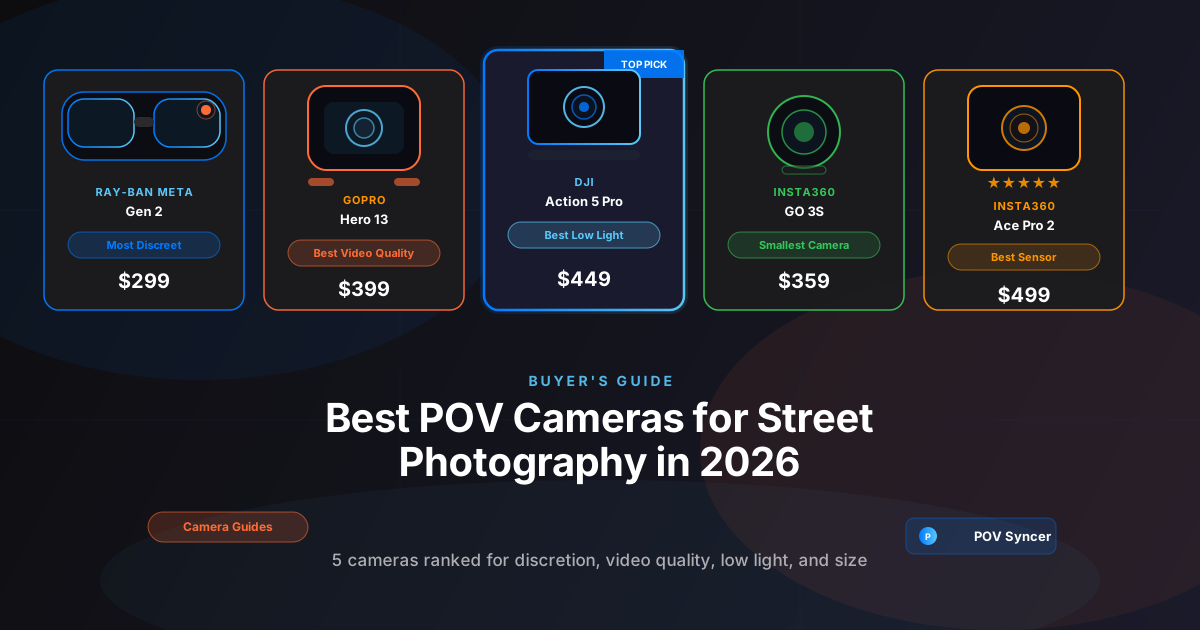
With those criteria in mind, here are the five best POV cameras for street photography in 2026, ranked from most specialized to most capable.
Get the free POV Photography Cheat Sheet
Optimal camera settings, EXIF sync tips, and export presets for all five cameras in this guide — plus 15 more camera combos — on one printable page. Free for subscribers.
Free PDF, no spam. Unsubscribe anytime.
1. Ray-Ban Meta Gen 2 — Most Discreet ($299)
If you want one camera that will change absolutely nothing about how people behave around you on the street, this is it. The Ray-Ban Meta Gen 2 looks like a pair of sunglasses or prescription frames because it is a pair of sunglasses or prescription frames. The 12MP camera sits inside the right temple, visible only as a small circle that most people assume is a decorative element.
Key Specs for Street Shooters
- Video: 1080p at 30fps or 60fps; 1080p is recommended for street
- Field of view: approximately 89 degrees (roughly 23mm equivalent) — the most natural-looking POV of any camera in this list
- Audio: five-microphone array with beamforming; genuinely excellent ambient audio capture
- Battery: approximately 60 minutes continuous recording; charging case extends to four hours total
- Stabilization: electronic, adequate for walking; not suitable for running
- Low light: acceptable at ISO equivalent up to about 800; softens noticeably in dim indoor light
Street Photography Pros
The invisibility factor is transformative. When you are wearing these glasses on a busy street, you are not a photographer with equipment — you are just someone walking around. Subjects behave naturally. You can hold a conversation with someone you want to photograph without a camera between you. The footage has a genuinely intimate quality that no helmet-mounted or chest-mounted camera can replicate, because it comes from eye level and does not signal its own presence.
The field of view is also remarkably close to the human visual field, which makes the footage feel natural rather than exaggerated. When a Fujifilm X100VI shot appears on the timeline at the moment you raised the camera, the relationship between what the glasses saw and what the X100VI captured is immediately legible. You see what drew your attention, then you see the frame you made from it.
Street Photography Cons
The Gen 2's sensor is behind the other cameras here in low-light and dynamic range. Shoot in shaded alleys, covered markets, or at dusk and you will see noise that you would not accept from your primary camera. The footage is also locked to Meta's color science, which skews warm — fine for Instagram but less suitable if you want to match the cooler tones of film simulation JPEGs from a Fujifilm.
There is no wind noise reduction worth speaking of. On breezy days, the audio can be unusable. The stabilization also does not handle stair climbing or anything more energetic than a purposeful walk.
Best Paired With
The Ray-Ban Meta Gen 2 is the natural partner for the Fujifilm X100VI, Ricoh GR IIIx, and Leica Q3 — cameras that are themselves discreet and that prioritize the decisive moment over burst coverage. The combination of invisible eyewear footage and a quiet, compact primary camera is the quietest, least intrusive street kit available.
2. GoPro Hero 13 — Best Video Quality ($399)
The GoPro Hero 13 is the current benchmark for action camera video quality, and it shows. The 1/1.9-inch sensor, GP2 processor, and HyperSmooth 6.0 stabilization together produce footage that is noticeably cleaner and more cinematic than any other camera in this list. If the quality of the POV footage itself is your primary concern, this is where you start.
Key Specs for Street Shooters
- Video: 5.3K at 60fps; 4K at 120fps; 1080p at 240fps for slow motion; recommended street setting is 4K30 or 1080p60
- Field of view: 155 degrees (ultra-wide default); Linear mode narrows to approximately 16mm equivalent; Max SuperView available
- Audio: three-microphone system with wind reduction; good but not as naturally ambient as the Meta glasses
- Battery: Enduro battery delivers 80-90 minutes at 4K30; swappable
- Stabilization: HyperSmooth 6.0 — industry-leading; smooth even jogging
- Low light: excellent; Night Lapse and Auto Low Light mode handle dusk and indoor conditions well
Street Photography Pros
The stabilization is genuinely exceptional. If you are shooting in a market, moving through a crowd, or walking quickly to keep up with an unfolding scene, the Hero 13 footage stays smooth in a way that cheaper cameras simply cannot match. The linear mode corrects the fish-eye distortion that makes ultra-wide footage feel artificial, delivering a usable field of view for street contexts.
The flat color profile (GoPro LOG) gives you full flexibility in post-processing to match the color science of your primary camera — important if you shoot with a Leica Q3 or Sony A7C II and want the primary camera stills to blend tonally with the POV video rather than fighting against it.
Street Photography Cons
The Hero 13 is unmistakably a piece of video equipment. Even mounted on a chest rig or hat clip rather than a helmet, it signals "this person is recording" in a way that the Meta glasses do not. Subjects who notice it will either perform for the camera or actively avoid being in your shot — neither of which is what you want for candid street work.
Battery is swappable, which is practical, but the camera itself requires a mount of some kind. There is no natural head-level mounting solution that does not look conspicuous. Chest mounting shifts your eye-level POV to chest-level, which feels odd when paired with stills shot from eye height.
Best Paired With
The Hero 13's video quality justifies pairing it with higher-resolution primary cameras: the Leica Q3, Sony A7C II, or Canon R6 III. These are cameras whose stills can fill a large screen without loss of detail, and the Hero 13's 4K footage can match their output in an edit without looking like a resolution mismatch.
3. DJI Action 5 Pro — Best Low Light ($449)
This is the camera I reach for when the light gets interesting — meaning when it gets difficult. The DJI Action 5 Pro's 1/1.3-inch sensor is the largest in any action camera at this price point, and the difference in low-light performance compared to the Hero 13 (1/1.9-inch) or the Meta glasses (smaller still) is visible and significant.
Key Specs for Street Shooters
- Video: 4K at 120fps; 1080p at 240fps; recommended street setting is 4K30 in Normal or D-Log M color profile
- Field of view: 155 degrees max; Rocksteady mode locks to approximately 19mm equivalent linear
- Audio: three-microphone array with wind noise reduction; DJI's audio processing is noticeably cleaner than GoPro in windy conditions
- Battery: up to 170 minutes at 1080p30 — the longest runtime of any camera in this guide
- Stabilization: RockSteady 4.0 and HorizonSteady; on par with HyperSmooth 6.0 in most conditions
- Low light: best in class for this camera category; usable footage at ISO 6400 equivalent
Street Photography Pros
The battery life story alone makes the Action 5 Pro compelling for street photography. A two-to-three-hour walk — the kind of session where the light changes from afternoon gold to blue-hour magic — is well within a single charge. Competing cameras require a mid-session battery swap, which means stopping, opening a case, and breaking the documentary continuity of the footage.
The D-Log M flat color profile gives you substantial post-processing flexibility. In practice, this matters most when you are pairing DJI footage with stills from a Fujifilm X-T5 or Leica Q3 in different lighting conditions — you can bring the POV video to match the stills, rather than the other way around.
Low-light performance is where the Action 5 Pro genuinely separates itself. Covered market stalls, shaded alleyways, subway stations, golden-hour streets with deep shadow areas — the footage stays clean and detailed in conditions where the GoPro Hero 13 and both Insta360 options start to show significant noise.
Street Photography Cons
Like the Hero 13, the Action 5 Pro is clearly a piece of video hardware. It does not disappear the way the Meta glasses do. The mounting options (chest, hat clip, bag strap) all place the lens somewhere other than eye level, which changes the subjective feel of the POV footage.
The price is the highest in this category for the standalone camera body. If you are budget-conscious, the performance gap between the Action 5 Pro and the Hero 13 may not justify the premium unless low-light performance is a specific priority for your work.
Best Paired With
The Action 5 Pro is the natural partner for low-light and high-contrast street shooting situations. Pair it with the Fujifilm X-T5, Sony A7CR, or Leica M11 — cameras that excel in challenging light and whose stills will benefit from POV footage that can keep up with them tonally.
Download POV Syncer Free — Create Your First POV Video in 60 Seconds4. Insta360 GO 3S — Smallest Camera ($359)
The Insta360 GO 3S is the size of a large grape. That is not a figure of speech — at 26.3mm in any dimension, it is genuinely tiny. The Action Pod that houses it is larger, but the camera module itself can be clipped to a collar, mounted inside a bag strap, or tucked into a button hole in a way that no other camera in this list can match.
Key Specs for Street Shooters
- Video: 4K at 30fps (with Action Pod); 2.7K at 30fps standalone; recommended street setting is 2.7K30 or 1440p30
- Field of view: 155 degrees; FlowState stabilization corrects to approximately 19mm linear equivalent
- Audio: single microphone on camera module; dual microphone with Action Pod; adequate but not outstanding
- Battery: 45 minutes standalone; Action Pod case provides up to 170 minutes total
- Stabilization: FlowState — impressive for the size; slightly behind Hero 13 and Action 5 Pro on aggressive movement
- Low light: weakest in this group; acceptable up to ISO 400 equivalent, degrades noticeably above that
Street Photography Pros
The GO 3S solves the visibility problem differently than the Meta glasses. Rather than looking like ordinary eyewear, it disappears entirely into your clothing or bag. A camera clipped to the inside of a shirt collar, or mounted on a shoulder bag strap at chest height, produces footage with almost no visual signature that you are recording anything.
The magnetic mounting system is genuinely clever for street use. You can reposition the camera between shots — move it from collar to bag strap to wrist band — without tools or clumsy clip systems. For photographers who want to vary the POV during a session, this flexibility is unique.
Weight and pack size are irrelevant. The GO 3S adds effectively nothing to your carry. If you already have a compact street kit — a Ricoh GR IIIx and a small bag — the GO 3S is the only POV camera here that does not require rethinking how you carry equipment.
Street Photography Cons
Low-light performance is the real limitation. For photographers who shoot primarily in shaded urban environments or after golden hour, the GO 3S footage will look soft and noisy in conditions where the DJI Action 5 Pro or even the GoPro Hero 13 produces usable footage. This is a physics constraint — the sensor is very small, and there is no engineering around that in dim light.
Audio is also the weakest in this group when using the camera standalone. The Action Pod improves this substantially, but the Pod adds bulk that partially defeats the "invisible camera" appeal.
Best Paired With
The GO 3S is the perfect match for ultra-compact street kits: the Ricoh GR III, Ricoh GR IIIx, or iPhone 16 Pro. Photographers who want a truly minimal carry — camera, phone, GO 3S — will find this combination produces compelling content without any compromise on mobility.
5. Insta360 Ace Pro 2 — Best Sensor ($499)
The Ace Pro 2 is Insta360's flagship action camera and it shows in the sensor specification. The 1/1.3-inch sensor (matching DJI) combined with the f/2.0 aperture (the widest of any camera here) and Leica-engineered optics make this the most capable imaging device in the action camera category, period.
Key Specs for Street Shooters
- Video: 8K at 24fps; 4K at 120fps; recommended street setting is 4K30 in LOG or Vivid profile
- Field of view: 128 degrees standard; Linear mode at approximately 19mm equivalent
- Audio: AI noise reduction audio; four-microphone array; the best wind noise handling of any camera in this list
- Battery: 100 minutes at 4K30 with standard battery; larger battery option available
- Stabilization: FlowState 2.0; on par with DJI and GoPro in practical use
- Low light: matches DJI Action 5 Pro; the f/2.0 aperture gives it a meaningful edge in the dimmest conditions
Street Photography Pros
The Leica-engineered optics are not a marketing exercise. The lens rendering on the Ace Pro 2 — the way it handles bokeh at the edges, the colour accuracy, the absence of the purple fringing that affects cheaper action camera lenses — is measurably better than the Hero 13 or Action 5 Pro when you pixel-peep the footage. For photographers who care deeply about optical quality, this is where you land.
The f/2.0 aperture works in low light in a way that no other action camera can match. At ISO 3200 equivalent in a shaded alley at dusk, the Ace Pro 2 produces footage that is genuinely usable alongside stills from a Leica Q3 or Nikon Zf — cameras that produce exceptional low-light results from their own much larger sensors. The footage will not match the stills technically, but it will not embarrass them either.
The AI wind noise reduction is the best in this category for photographers who shoot in coastal cities, open plazas, or anywhere wind is a consistent challenge. The audio the Ace Pro 2 captures in conditions that make other cameras sound like a hurricane is clean, directional, and genuinely documentary-grade.
Street Photography Cons
At $499, the Ace Pro 2 is the most expensive camera in this guide. If you are pairing it with a Ricoh GR III at $800 or a Fujifilm X100VI at $1,599, the math works. If you are pairing it with a smartphone as your primary camera, you may find yourself spending more on the POV camera than the stills camera, which is an unusual position.
The form factor is conventional action camera — a rectangular box that is unmistakably a video device. The same visibility concerns that apply to the Hero 13 and Action 5 Pro apply here.
Best Paired With
The Ace Pro 2 belongs alongside the best street cameras available: the Leica Q3, Leica M11, Nikon Zf, or Sony A7C II. These are cameras whose owners have already invested in optical quality, and the Ace Pro 2 is the only POV camera here that can credibly keep up with them.
Want settings cheat sheets for 20+ camera combos?
Join 1,000+ photographers getting weekly tips — including dedicated cheat sheets for every camera pairing in this guide. Optimal settings, EXIF sync notes, and export presets, all free.
Free weekly tips. Unsubscribe anytime.
The Editing Problem — and How to Solve It in Seconds
Picking the right POV camera solves the footage problem. It does not solve the editing problem. And for street photographers, the editing problem is the real barrier between intention and published content.
Here is what manual editing of a street photography POV video actually looks like in Premiere Pro or Final Cut Pro. You import the glasses footage — say, 90 minutes of Ray-Ban Meta video from a morning session. You import 60 JPEG stills from the X100VI. You scrub through the footage until you find the approximate timestamp when you raised the camera for a shot. You drag the JPEG onto the timeline. You play back and adjust the position by hand because the timestamp match was not precise enough. You repeat this 59 more times. Then you add titles. Then you add narration or music. Then you adjust the export settings.
That workflow, done carefully, takes between two and four hours for a 10-minute finished video. Three hours of editing for every session is not a creative practice — it is a second job that most photographers abandon after the first few attempts.
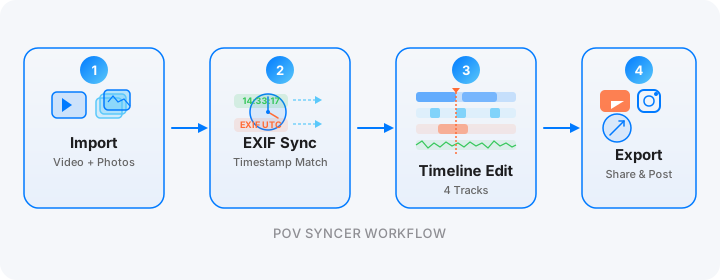
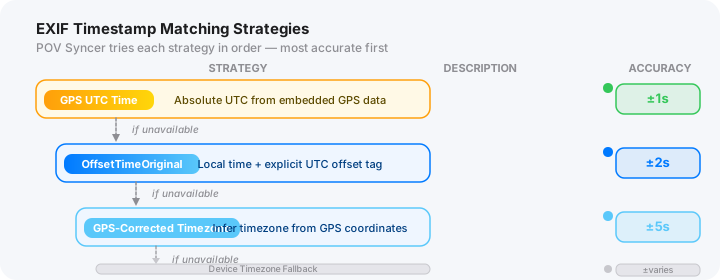
POV Syncer replaces that entire workflow with automatic EXIF timestamp matching. The app reads the DateTimeOriginal field from every JPEG or RAW file and the start timestamp from your POV camera video, calculates the frame-perfect position of each photo on the timeline, and places them all automatically. For a session with 60 photos, what took hours manually takes under 60 seconds.
How the Sync Works Across Different POV Cameras
Each of the five cameras in this guide writes video metadata slightly differently. Ray-Ban Meta embeds a start timestamp in the MP4 container. GoPro and DJI use their own metadata formats. Insta360 has its own file structure. POV Syncer handles all of these automatically — there is no configuration required based on which POV camera you are using.
The one variable you control is clock sync. Your POV camera's clock and your primary camera's clock need to agree. For the Ray-Ban Meta and GoPro, the app on your phone keeps the camera clock in sync automatically. For DJI and Insta360 cameras, sync happens via the companion app on first connection. For your primary street camera — Fujifilm, Leica, Nikon, Sony — you need to set the clock manually before each session by comparing it to your phone's time. This takes 30 seconds and makes the difference between a perfect automatic match and stills that appear a few seconds early or late.
After the Auto-Match: Finishing the Video
Once POV Syncer has placed your stills on the timeline, you have a nearly finished video. Trim the start and end, cut any dead time in the middle, add a title card with location and date from the 15 available fonts, optionally add a brief AI narration voice-over, and export. For a 10-minute street video, this finishing work takes 15-20 minutes — not the two to four hours that manual editing in Premiere requires.
Visit the features page to see the full timeline editor and all export options, or check the pricing page for a comparison of the free and Pro tiers.
Quick Comparison: Which Camera to Buy in 2026?
To make the decision simple, here is how I would guide a buyer based on their primary concern:
- If discretion is everything: Ray-Ban Meta Gen 2 ($299). Nothing else comes close for candid street work. The footage is not the best in class, but the authenticity of what it captures makes up for it.
- If video quality is everything: GoPro Hero 13 ($399) or Insta360 Ace Pro 2 ($499). The Hero 13 is the cleaner value; the Ace Pro 2 has the better optics and sensor if budget allows.
- If low light is your primary environment: DJI Action 5 Pro ($449). The sensor size and battery life combination is unmatched for long sessions in difficult light.
- If pack weight is everything: Insta360 GO 3S ($359). The only camera here that genuinely adds nothing to your carry weight or visual profile.
- If you own a Leica or Sony A7 series camera: Insta360 Ace Pro 2 ($499). The optical quality of the Leica-engineered lens is the only POV footage that does not embarrass high-end primary cameras.
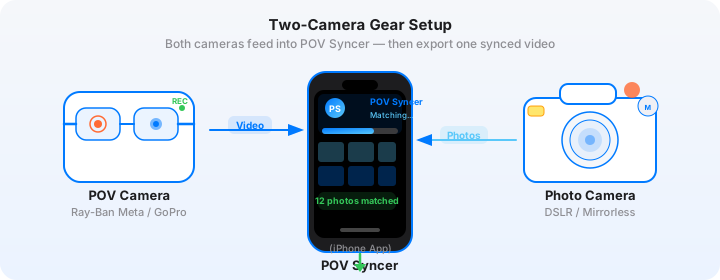
All five cameras work with POV Syncer. Regardless of which one you choose, the automatic EXIF sync workflow is the same — import footage and photos, let the app match timestamps, refine the timeline in minutes, and export. The camera decision is about the footage quality and field experience. The editing experience is consistent across all of them.
Conclusion
Street photography has always been about the moment — the fraction of a second when light, subject, and instinct align. Your POV camera is the witness to the process that produces those moments. The Ray-Ban Meta Gen 2 witnesses it most authentically. The DJI Action 5 Pro witnesses it in the most difficult light. The GoPro Hero 13 and Insta360 Ace Pro 2 witness it with the most visual fidelity. The Insta360 GO 3S witnesses it without anyone knowing it is there.
The right choice depends on your work and your street. What does not depend on anything is the editing equation: hours of manual timeline scrubbing in Premiere, or automatic EXIF sync in under 60 seconds with POV Syncer. That part is easy.
Turn your street footage into a finished video today
Download POV Syncer free and connect any of the five cameras in this guide to your street photography stills — automatic EXIF sync, AI narration, 15 premium fonts.
Or get the free cheat sheet for all 5 cameras in this guide:
Free PDF. No spam. Unsubscribe anytime.