Wedding Photographer POV: Avoiding the 'Stiff Posed Shot' Look
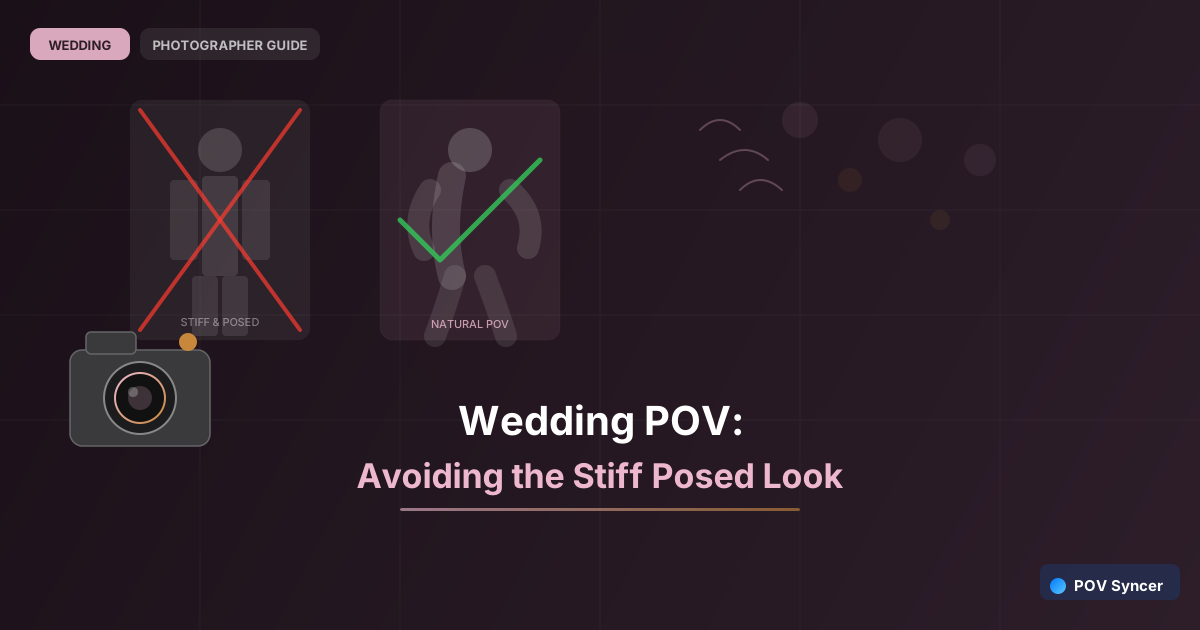
Every couple who has ever been to a wedding in the past decade has seen those photographs. The bridal party lined up on a staircase, arms at identical angles, smiling at varying degrees of convincingness. The couple holding hands and staring at each other with the specific expression of two people who have been told to look at each other. The groom's parents positioned in front of a hedge.
These are the photographs that prospective couples are specifically trying to avoid when they search for a wedding photographer. "Natural." "Unposed." "Candid." "Documentary style." These are the terms they type into Google because they have a visceral reaction to the alternative, and they want proof — real proof, not just marketing copy — that you can deliver something different.
POV video is that proof. It does something that a portfolio of beautiful natural-looking images cannot do alone: it shows the process that produces those images. When a couple watches your Ray-Ban Meta footage of you working quietly at the edge of a ceremony, not directing anyone, just watching and shooting, they understand at a gut level that the natural-looking photographs in your gallery are genuinely natural. You were not staging them. You were catching them.
The Problem With Claiming You Are "Natural and Unposed"
Half the wedding photographers in any market describe their style as natural, documentary, or candid. The word has been diluted to near-meaninglessness. A couple reading "I love capturing natural moments" on a photographer's About page has no way to evaluate whether that claim is true without additional evidence.
The additional evidence, until recently, was the portfolio. And portfolios are curated. Even a photographer who spends 80% of the day doing posed family formals can show a gallery of 50 images that looks entirely documentary. The portfolio selects for the best results, not the typical process.
POV video shows the process. It is much harder to misrepresent. If you spent the ceremony standing back and shooting quietly, your Ray-Ban Meta footage shows that. If you spent it directing people into positions, that is visible too. For photographers who genuinely work in a natural, unobtrusive style, POV content is the most compelling evidence they can produce. It validates every claim on their website in a way that static images cannot.
What "Natural" Actually Looks Like in POV Footage
There are specific visual signatures in POV footage that signal a natural shooting style to viewers — including prospective clients who may not be able to articulate why the footage feels different.
Distance and Position
Your Ray-Ban Meta footage shows how far you were standing from the subjects. A photographer working in a genuinely unobtrusive style tends to keep distance and use a longer focal length on their stills camera. That distance — visible in the footage as you standing at the edge of a room, or behind a row of guests — communicates restraint. Viewers register it as "this photographer was not in their faces."
Movement Patterns
Documentary wedding photographers tend to move in arcs around scenes rather than moving toward and away from subjects repeatedly. They position once, commit, and wait. The POV footage of this kind of movement has a specific quality: purposeful, patient, without the constant back-and-forth of someone who is directing and adjusting.
The Quiet Before the Shot
The most telling moments in documentary wedding POV footage are the pauses. The seconds of footage where you are holding still, watching, waiting for a moment to resolve itself. That stillness, visible in the Ray-Ban Meta footage as a fixed point of view observing a scene, reads as attentiveness rather than imposition. It is the visual signature of a photographer who photographs what is happening rather than making things happen for the camera.
Get the free POV Photography Cheat Sheet
Camera settings, EXIF sync tips, and export presets for Ray-Ban Meta, GoPro, DJI Action, and Insta360 — all on one printable page.
Free PDF, no spam. Unsubscribe anytime.
Building the Reel That Proves Your Approach
The specific structure of a natural-style wedding POV reel is slightly different from a general highlight reel. The emphasis is on the gap between what the scene looked like from your position — often modest, informal, unremarkable — and what the photograph captures. That gap is the argument.
Choose Moments With Unglamorous POV Footage
This sounds counterintuitive, but the most persuasive natural-style reels deliberately show moments where the POV footage is not particularly beautiful. A child wandering across a ceremony aisle. Guests looking at their phones between speeches. The couple standing awkwardly after the first kiss, unsure what to do with themselves.
These scenes, followed by the revealed photographs from those same moments, make the point better than any caption could. The viewer sees ordinary reality on the left side of their brain and the extraordinary image it produced on the right. The conclusion — "this photographer finds moments rather than manufacturing them" — arrives without you having to say it.
The Editing Process in POV Syncer
Import your Ray-Ban Meta footage and your stills camera JPEGs into POV Syncer. The app reads the DateTimeOriginal EXIF timestamp from every photograph and places it at the exact corresponding frame in your video — no manual scrubbing, no guesswork. For natural-style content, this automatic sync is particularly valuable because the most compelling moments are the ones you cannot easily relocate by memory. The EXIF timestamp finds them for you.
In the timeline, look for the moments where your POV footage shows you at a distance, holding still, and your stills camera captured something that was happening without intervention. Those are your primary sync moments. Build the reel around them.
Keep Narration Honest and Brief
If you add AI narration (available in POV Syncer Pro), keep it factual and brief. Describe what was happening, not how good the photograph is. "The flower girl had decided she was done with the whole thing. I waited." That kind of narration — unpretentious, specific, slightly funny — reinforces the natural style without over-explaining it.
The Couples Who Book From This Content
The enquiries that come from natural-style POV content are some of the most pre-qualified leads in wedding photography. The couple has watched you work. They have seen that you are quiet, patient, and unobtrusive. They have seen the photographs that result. By the time they send a DM, they are not evaluating you — they are checking availability.
These are also the clients most likely to give you full creative latitude on the day, to trust your positioning decisions, and to be genuinely delighted by the delivered gallery rather than disappointed because it did not match unrealistic expectations set by overly directed content.
The POV format self-selects for the right clients in a way that even the best portfolio cannot.
A Note on What Not to Include
One thing that undermines natural-style POV content is including footage of you giving directions. Even brief, gentle direction — "can you walk toward each other slowly," "just laugh together for a second" — reads as manipulation to viewers who are specifically trying to avoid posed photography. If you do need to direct couples during portrait time, edit those moments out of your reel. Keep the footage that shows you observing, not orchestrating.
This is not dishonest. Every photographer directs couples to some degree. The natural style is about what proportion of the work is directed versus observed. If your portrait sessions are primarily observation with minimal direction, that is the truth your POV footage should convey.
For further context on structure, see what to sync and what to cut in a 60-second recap, and why couples now choose photographers via POV video.
Show your natural approach — automatically
Download POV Syncer free. Import your footage and stills. EXIF sync finds the candid moments without any scrubbing.
Download POV Syncer Free