The Rise of POV Photography Content on TikTok and Instagram
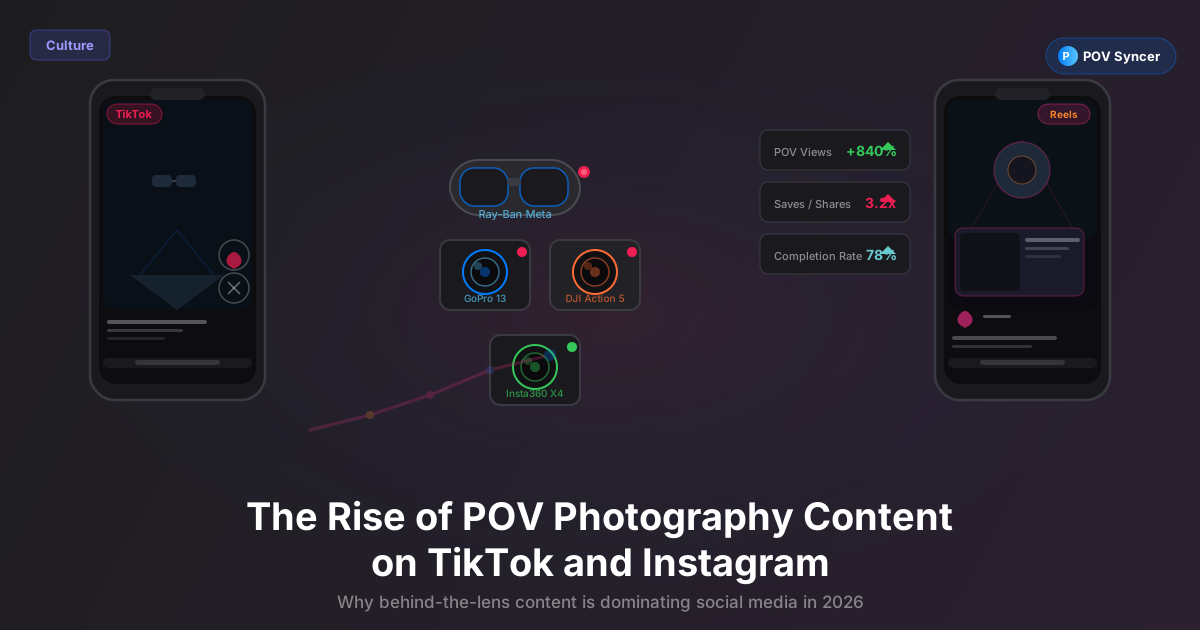
Something shifted on social media in the past few years. The content that gets watched, shared, and followed is no longer the most polished. It is the most present. POV photography — first-person video from action cameras and smart glasses, cut together with the actual stills from a dedicated camera — is now one of the dominant formats on both TikTok and Instagram. Here is the cultural story of why, and what it means for photographers who are still spending 3 hours in Premiere to produce what should take 60 seconds.
The Moment POV Photography Hit the Mainstream
It is hard to pinpoint a single moment, but there is a reasonable case to make that the cultural shift began around 2022 and 2023, when Ray-Ban Meta smart glasses started showing up in street photography content. A frame-within-a-frame that nobody saw coming: eye-level footage of a photographer walking through a city, and then — at the exact second the shutter fires — a crisp, deliberate, beautifully composed photograph appears on screen.
Photographers had been doing something like this for years with GoPros on chest mounts and helmet cams. But it had always looked like it belonged to the action sports world — stabilised footage of mountain bikes and surf breaks, not the quiet deliberation of someone working a Tokyo side street with a Fujifilm X100VI. The arrival of glasses-mounted cameras changed the register entirely. The footage suddenly looked like the way photographers actually see. Not wide-angle extreme sport energy, but genuine human eye-level perspective with natural head movement and the quiet intentionality of someone paying close attention to the world.
That visual shift unlocked an audience that was not looking for action content. It unlocked people who love photography, want to understand how great photographs come to exist, and had never seen the process shown to them this clearly before.
Why the Format Works So Well on These Platforms
There are a few overlapping reasons POV photography content performs as well as it does on TikTok and Instagram, and they are worth unpacking properly because they are not accidental.
It Has Built-In Forward Momentum
The fundamental problem with showing photographs on social media is that a still image gives the viewer everything at once. There is no reason to keep watching. POV video solves this with an elegant structural trick: the viewer knows a photograph is coming, but they do not know when, or what it will look like. The moment of the shutter click — visible in the footage as the camera being raised, audible as the click itself — functions as a reveal. The viewer stays to see the payoff.
This is exactly the narrative tension that platform algorithms reward. TikTok measures completion rate and rewatch rate. A video where the payoff comes at the 80% mark produces strong completion numbers because viewers stay. Instagram Reels measures saves — and people save content they want to watch again, or reference later for the technique. POV photography content with a clear photo reveal gets saved because photographers want to come back and study the framing.
It Is Genuinely Educational Without Feeling Like a Tutorial
Written tutorials explain technique. Video tutorials show technique. POV photography does something more rare: it puts you inside someone else's process in real time. You experience the scene from the photographer's perspective before they even raise the camera. You see what they saw. You feel the moment of decision. That experiential quality is impossible to replicate with any other format, and it is why photographers who post this content consistently report higher engagement than when they post portfolio images alone.
Authenticity Is the Currency These Platforms Actually Trade In
Both TikTok and Instagram have gone through a visible cultural correction over the past few years. The hyper-produced, heavily filtered aesthetic that dominated 2018 through 2021 has given way to something more raw and present. Audiences on both platforms now have finely tuned radar for content that feels staged or over-engineered. POV photography bypasses this entirely because it cannot be faked in any conventional sense. The footage is the photographer actually being there, seeing what they see, moving the way they move. The photograph that emerges is evidence of a real decision made in a real moment.
Get the free POV Photography Cheat Sheet
Camera settings, EXIF sync tips, and export presets for Ray-Ban Meta, GoPro Hero 13, DJI Action 5 Pro, and Insta360 X4 — all on one printable page. Used by 1,000+ photographers every week.
Free PDF, no spam. Unsubscribe anytime.
The Cameras Behind the Trend
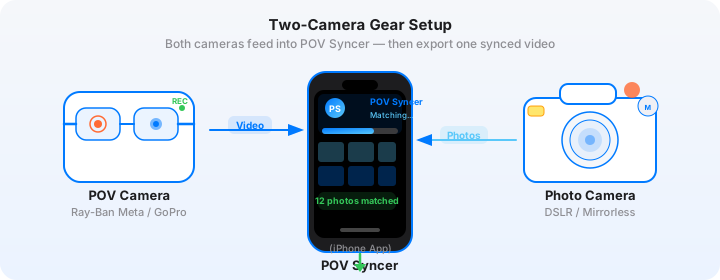
Four cameras have driven the majority of the POV photography content trend. They represent different philosophies and use cases, but they share a common property: they produce footage that reads as genuinely first-person rather than as "camera on a stick."
Ray-Ban Meta Gen 2: The Invisible Camera
The Ray-Ban Meta Gen 2 glasses are the camera that most directly caused the visual shift described above. They shoot at 1080p at up to 60fps with a field of view that corresponds closely to what the human eye naturally sees. Because they look exactly like sunglasses, the footage they produce looks like how a human being actually moves through the world — no visible camera housing, no stabilisation that looks mechanical, no wide-angle distortion. The footage has presence.
For street photography specifically, the glasses are the single best POV camera because they are socially invisible. Subjects on the street do not know they are being filmed. The footage captures genuine, unrehearsed human scenes. When a crisp Fujifilm X100VI or Leica Q3 photograph appears in the video — placed automatically at the exact EXIF timestamp — the contrast between the wide, continuous eye-level footage and the tightly composed still image creates the visual tension that drives engagement.
GoPro Hero 12 and 13: The Action and Adventure Driver
The GoPro Hero 13 brought 5.3K at 60fps and HyperSmooth 6.0 stabilisation to a camera small enough to clip to a camera strap. For photographers working in environments with more movement — hiking, cycling, festivals, busy markets — the GoPro's stabilised wide-angle footage provides more environmental context than the narrower Ray-Ban Meta field of view.
GoPro-based POV photography content has driven enormous growth on TikTok specifically in the adventure and travel categories. The format is consistent: chest-mounted or head-mounted GoPro footage of an environment, with photos from a Fujifilm X-T5 or Sony A7C II appearing at the exact moments they were taken. The wide GoPro frame shows the whole scene. The photo shows what the photographer chose to see within it. The juxtaposition is the education.
DJI Action 4 and 5 Pro: The Quality Jump
DJI's action cameras brought 4K HDR to the POV format along with RockSteady stabilisation that rivals any camera in the class. The DJI Action 5 Pro in particular has become the preferred choice for photographers who want footage quality close to a dedicated cinema camera without the form factor penalty. At 4K/120fps with log colour profiles, the footage holds up to serious colour grading — which matters when the still photos being cut in are shot with Leica Q3 or Sony A7CR files at their full potential.
Insta360 X4 and GO 3S: Format Flexibility
Insta360's cameras contribute something different: the ability to reframe footage after the fact. The X4's 8K 360-degree capture means you can choose the perspective in post — forward-facing for POV, tilted for context, wide for establishing shots. The GO 3S is the smallest action camera in the group, small enough to clip to a camera strap or the brim of a hat, producing footage that looks genuinely casual and first-person in a way even the Ray-Ban Meta cannot match for certain shooting situations.
The Manual Editing Problem That Was Killing the Format
Here is the part of the story that the trend articles never mention, because it was invisible to everyone except the photographers actually trying to do this work.
For the first couple of years that this content format existed, producing a single 60-second behind-the-shot Reel required 2 to 4 hours of manual editing. You had to import the footage into Premiere Pro or Final Cut Pro. You had to scrub through it looking for the moments that corresponded to your photographs. You had to manually drag each photo onto the timeline and line it up with the video frame that showed the same scene. Then you had to add text, adjust audio, and export in a format that the platform would accept without re-encoding everything.
For a 90-minute street walk that produced 45 photographs and three clips of Ray-Ban Meta footage, this was genuinely hours of work. The photographers who built large audiences on this format in its early days were not just good photographers — they were also people with desktop editing setups and the patience to spend a Sunday afternoon in a timeline scrubbing for the exact frame.
That barrier kept the format smaller than it should have been. The photographs were good. The footage was compelling. But the editing was a grind that most photographers with day jobs could not sustain at the frequency social platforms reward.
Skip the editing grind. Do it in under 60 seconds.
POV Syncer uses automatic EXIF sync to place every photo at its exact moment in your footage — no scrubbing, no manual alignment, no Premiere required. What took hours is now done before your coffee gets cold.
Download POV Syncer FreeFree tier includes one project. Pro: $9.99/month or $99.99/year — AI narration, 15 fonts, unlimited projects.
How Automatic EXIF Sync Changed the Equation
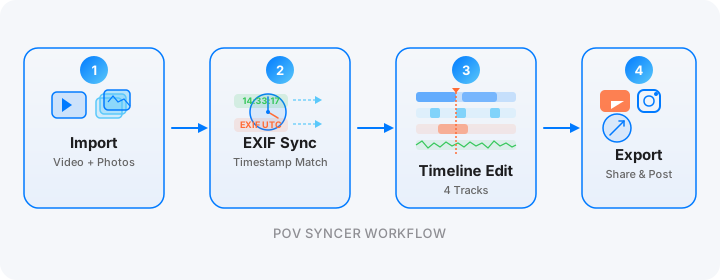
Every digital photograph contains an EXIF timestamp in its metadata — the precise moment, down to the second, at which the shutter fired. Every action camera and smart glasses records its video with an internal clock. If both clocks are correctly set, the relationship between every photograph and every video frame is a simple arithmetic calculation: the photo belongs at the video timecode that corresponds to its EXIF DateTimeOriginal timestamp.
POV Syncer is built around this insight. Import your Ray-Ban Meta or GoPro footage alongside your Fujifilm X100VI or Ricoh GR IIIx photographs, and the app reads the EXIF data from every photo and finds its corresponding moment in the video timeline. Automatically. In seconds. No scrubbing required.
Four Matching Strategies for Imperfect Real-World Conditions
The elegance of EXIF matching is that it works even when conditions are not perfect. POV Syncer uses four matching strategies in sequence: GPS UTC timestamp (the most precise, available when your camera has GPS lock), OffsetTimeOriginal EXIF field (the UTC offset data that cameras like the Fujifilm X100VI and Ricoh GR IIIx store when you set the timezone correctly), GPS-corrected timezone inference, and device timezone fallback. Working through these in order means the matching succeeds even when clocks are slightly out of sync or GPS data is unavailable.
After the automatic placement, you review the timeline and can fine-tune any individual photo by dragging it a few frames. For a session with 40 photographs across 90 minutes of footage, the entire workflow — import, match, review, add text, export — takes under 15 minutes. Not 3 hours. Fifteen minutes. That is the shift that makes the format sustainable at social posting frequency.
The Cultural Shift: What Audiences Are Actually Responding To
The Collapse of the Portfolio Account Model
For much of the last decade, the dominant model for photographers on Instagram was the portfolio account: a grid of beautiful images, maintained with careful curation, the imperfections and process carefully edited out. This model worked when Instagram was primarily a discovery platform for visual aesthetics. Brands would find photographers through their portfolio grids. Other photographers would follow for inspiration.
That model has not disappeared, but its cultural centrality has eroded. The accounts with genuinely large and engaged followings in 2025 and 2026 are much more likely to be showing process than product. The photograph is still there — but it is earned within the content rather than presented as the point of the content. Viewers feel they have witnessed something rather than been shown something. That distinction is everything on platforms built around watch time and shares.
The New Standard: Earn the Still
The phrase I keep hearing from photographers who have made this shift is "earn the still." The photograph at the end of a behind-the-shot Reel or Short is more affecting than the same photograph posted as a standalone image because the viewer has been brought through the process of its making. They have stood in the shoes of the photographer, seen what the photographer saw, felt the anticipation of the shutter click. When the photo appears, they understand it more fully than if it had simply been presented to them.
This is not a gimmick. It is a genuine restoration of something that was lost when photography moved fully onto social media: the context of the image's making. POV video is the closest thing we have found to a way of sharing that context at scale.
Why the Trend Will Outlast the Platforms
TikTok and Instagram are the current distribution channels. They will not be the last ones. But the underlying desire that POV photography content satisfies — the desire to understand how things are made, to see through someone else's eyes for a few seconds, to connect the photograph to the human being who made the decision to take it — that desire does not belong to any platform. It is a permanent feature of how people relate to visual art.
The cameras that enable this format — Ray-Ban Meta, GoPro, DJI, Insta360 — are in only the second generation of their existence. They will get smaller, sharper, longer-lasting. The format will evolve with them. But its cultural logic, the reason it connects with audiences, is not technological. It is human.
Want settings cheat sheets for 20+ camera combos?
Join 1,000+ photographers getting weekly tips on POV setups, EXIF sync, and social export workflows. Every camera combination covered — Ray-Ban Meta to GoPro to DJI, paired with Fujifilm, Leica, Ricoh, Sony, and more.
Free, no spam. Unsubscribe anytime.
How to Start Creating POV Photography Content Today
The barrier to entry for POV photography content has never been lower. Here is the practical path from zero to your first published behind-the-shot video.
Step 1: Choose Your POV Camera
If you prioritise authentic street presence and minimal footprint, start with Ray-Ban Meta Gen 2. They are the most invisible option and produce the most natural eye-level footage. If you prioritise image quality and stabilisation for more active or adventurous environments, the GoPro Hero 13 or DJI Action 5 Pro are the right tools. If you want reframing flexibility and the ability to generate multiple angle options from a single shoot, the Insta360 X4 is the choice.
Any of these pairs with any capable street camera. The pairings that are consistently producing the strongest content right now: Ray-Ban Meta Gen 2 with a Fujifilm X100VI (the aesthetic match is exceptional), GoPro Hero 13 with a Ricoh GR IIIx (wide environmental context plus compressed street geometry), DJI Action 5 Pro with a Leica Q3 (serious dynamic range in both the video and the stills), and Insta360 GO 3S with a Sony A7C II (maximum compactness with full-frame quality).
Step 2: Sync Your Clocks Before You Shoot
This is the one technical step that determines whether automatic EXIF sync works perfectly. Before every session, check that your POV camera's clock matches your phone's clock (Ray-Ban Meta and GoPro do this automatically when connected to their apps — just open the app before you head out). Then check your street camera's clock against your phone. The Fujifilm X100VI, Ricoh GR IIIx, and most other street cameras do not have GPS or network time sync, so they rely on the clock you set manually. A one-second offset means your photos appear one second early or late in the footage. For a decisive moment in street photography, that matters.
Step 3: Shoot Normally
Start your POV camera recording before you begin shooting. Walk, observe, and take photographs as you normally would. The POV camera captures everything continuously. Your street camera captures the deliberate moments. You do not need to do anything differently — the EXIF timestamps are being written to every photo automatically, whether you are thinking about them or not.
Step 4: Import and Sync in POV Syncer
Transfer your footage and photos to your iPhone. Open POV Syncer, create a new project, and import both. The automatic EXIF matching runs and places every photo at its corresponding moment in the video timeline. For a 90-minute walk with 40 photographs, this takes seconds — not the hours of manual scrubbing that Premiere or Final Cut would require.
Step 5: Edit and Export
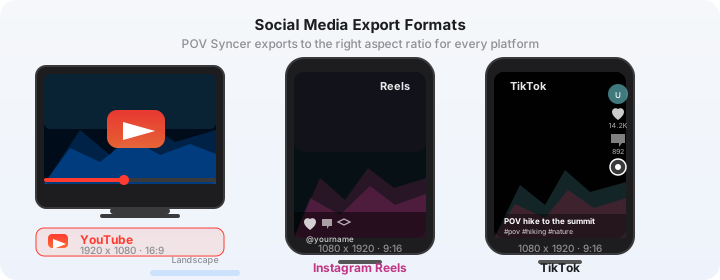
Review the timeline, adjust any photo placements that need fine-tuning, trim the footage to your desired length, and optionally add AI-powered narration from one of 15 available voices. Export in 9:16 for TikTok and Instagram Reels, or 16:9 for YouTube. Share directly from POV Syncer or save to your camera roll for posting through the native apps.
What the Finished Video Actually Looks Like
Here is a concrete example. You are walking through a covered market, Ray-Ban Meta recording, Fujifilm X100VI in your hand. The light through the market roof is falling at a low angle across a produce stall. You stop, compose for two seconds, and take one frame. The EXIF timestamp reads 10:47:23.
In POV Syncer, that photograph appears at the 10:47:23 mark in the Ray-Ban Meta footage. The footage before it shows you walking toward the stall — the light, the composition developing, the moment of decision. The photograph appears and holds for 3 seconds: the scene transformed by the X100VI's sensor and film simulation into something still and deliberate. Then the footage continues.
The total video is 35 seconds. It took you 8 minutes to edit. The comments fill with photographers asking about the focal length and the light. Some ask how you synced the footage. You tell them. The cycle continues.
The Bigger Picture: Photography Culture Is Sharing Its Process
The rise of POV photography content on TikTok and Instagram is not fundamentally a story about technology. It is a story about what photography culture has been wanting to express for a long time but lacked the tools to express accessibly.
Photographs have always carried an invisible context: the person who made the decision to take them, standing in a specific place at a specific moment, seeing something that most people walked past. That context is the photography. The final image is only the residue of it. POV video — first-person footage from a camera that sits at eye level and captures the approach and the decision — is the first format that makes that invisible context visible without destroying the photograph in the process.
The platforms that reward this format are doing so because their audiences want it. The cameras that enable it are in the second generation of a long product roadmap. The tools that remove the editing barrier — automatic EXIF sync, one-tap photo matching, AI-powered narration, 15 premium fonts, direct social export — are now available to any photographer with an iPhone.
What took 3 hours of tedious timeline placement in Premiere now takes under 60 seconds. That is not just a workflow improvement. It is the thing that makes posting this content sustainably possible. And sustainable posting frequency is what the format has always needed to reach its full cultural moment.
Create your first POV video in 60 seconds
Download POV Syncer free. Import your footage and photos. Automatic EXIF sync places every photo at the exact moment it was taken. No Premiere. No scrubbing. No hours of manual editing.
Download on App Store — FreeOr join 1,000+ photographers getting weekly tips:
Free PDF cheat sheet on signup. No spam. Unsubscribe anytime.